Promoting Industrial Symbiosis and International Cooperation for a More Sustainable Future
15–16 October 2025 | Kraków, Poland
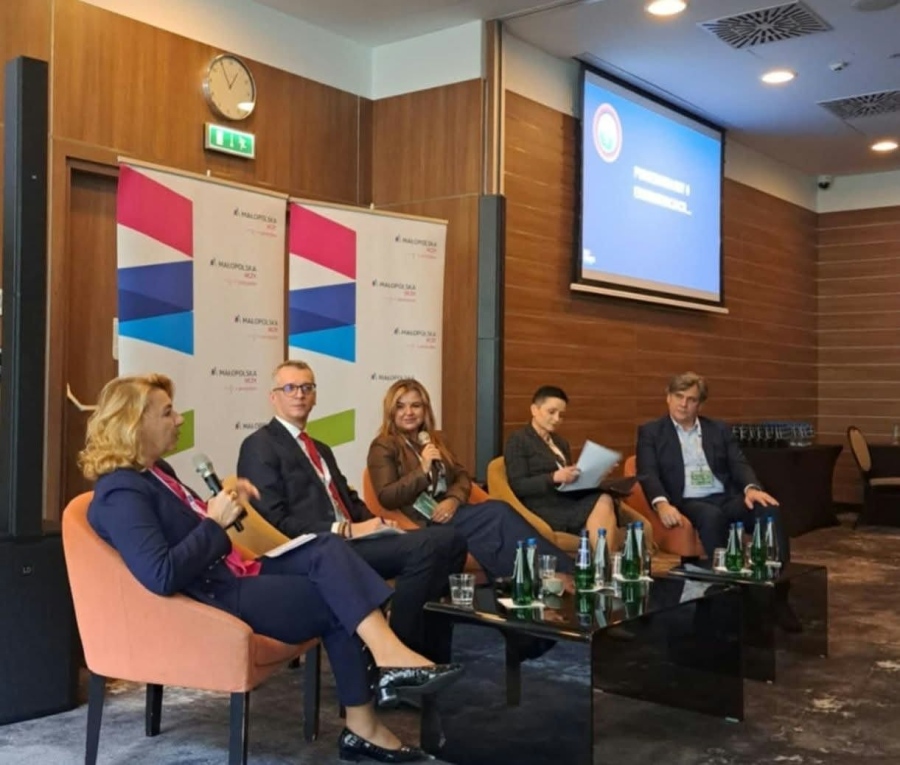
The SymbioTech project was presented at the Małopolska Congress “Climate – Circular Economy – Air Quality” (Klimat – GOZ – Powietrze), held on 15–16 October 2025 in Kraków, Poland. The event brought together more than 300 representatives of local and regional authorities, academia, businesses, environmental organisations and other stakeholders to discuss practical approaches to climate protection, resource efficiency and the transition towards a circular economy.
During the conference, Dr Eng. Monika Pec from AGH University of Krakow, Faculty of Management, participated in the panel discussion “Climate, Circular Economy and Air Quality – Our Common Challenges”, where she introduced the SymbioTech project and highlighted its innovative approach to industrial symbiosis, sustainable resource management and international collaboration.
The congress provided an excellent opportunity to raise awareness of SymbioTech among several hundred conference participants and promote the project's objectives beyond the academic community, reaching policymakers, business representatives and practitioners involved in the green transition.
From Industrial Waste to Valuable Resources
One of the key messages presented during the discussion was that industrial symbiosis represents much more than an environmental initiative. It offers a practical management approach through which companies can transform waste, by-products, surplus energy and other underutilised resources into economic and environmental value.
Dr Pec explained how the SymbioTech project seeks to strengthen the competencies required to identify industrial symbiosis opportunities, establish partnerships between enterprises and develop effective models of interorganisational cooperation.
Particular attention was given to the practical application of the project's results, including the development of educational resources, specialised training pathways and digital solutions supporting cooperation between enterprises.
These activities aim to help organisations identify potential resource exchanges, improve resource efficiency, reduce waste management costs and discover new opportunities for sustainable innovation.
Why International Cooperation Matters
An important part of the discussion focused on the added value of participating in international projects and the measurable benefits such cooperation can bring to universities, enterprises and regional development.
Dr Pec emphasised that international collaboration enables partners to exchange knowledge, compare experiences across different economic and institutional environments, access complementary expertise and jointly develop solutions that would be more difficult to achieve independently.
For businesses, this means opportunities to discover innovative practices, establish new partnerships and gain access to international networks. For universities, international projects strengthen research capacity, support the development of modern educational programmes and facilitate the transfer of knowledge into practical applications.
The discussion also addressed how to encourage organisations to become more actively involved in preparing and implementing international projects. An essential message was that participation should be viewed not simply as an opportunity to obtain external funding, but as a strategic investment in knowledge, competencies, partnerships and long-term organisational development.
Connecting Research, Business and Regional Development
The participation of AGH University of Krakow in the congress demonstrated the importance of connecting academic research with the practical needs of businesses and public institutions.
Industrial symbiosis requires more than technological solutions. Its successful implementation also depends on trust, communication, managerial competencies, organisational readiness and the willingness of different stakeholders to cooperate.
By bringing together representatives of science, business and public administration, events such as the Małopolska Congress create valuable opportunities to strengthen these relationships and encourage new collaborative initiatives.
The presentation of SymbioTech contributed to the dissemination of the project's objectives and opened opportunities for dialogue with stakeholders interested in circular economy solutions and international cooperation.
Looking Ahead: Turning Cooperation into Action
The central message of the SymbioTech contribution was clear: the transition towards a circular economy requires collaboration across organisational, sectoral and national boundaries.
Through its international partnership, SymbioTech aims to transform knowledge into practical competencies, educational tools and solutions that can support enterprises in implementing industrial symbiosis.
The congress offered an important platform for increasing the project's visibility, sharing its innovative approach and encouraging stakeholders to explore the opportunities offered by European cooperation.
SymbioTech continues to demonstrate how international partnerships can connect research, education and industry to create practical solutions for a more resource-efficient, collaborative and sustainable economy.
Project dissemination activity: Participation in a regional congress and promotion of SymbioTech among representatives of public administration, academia, business and civil society.
 Funded by the European Union. Views and opinions expressed are however those of the author(s) only and do not necessarily reflect those of the European Union or the European Education and Culture Executive Agency (EACEA). Neither the European Union nor the granting authority can be held responsible for them.