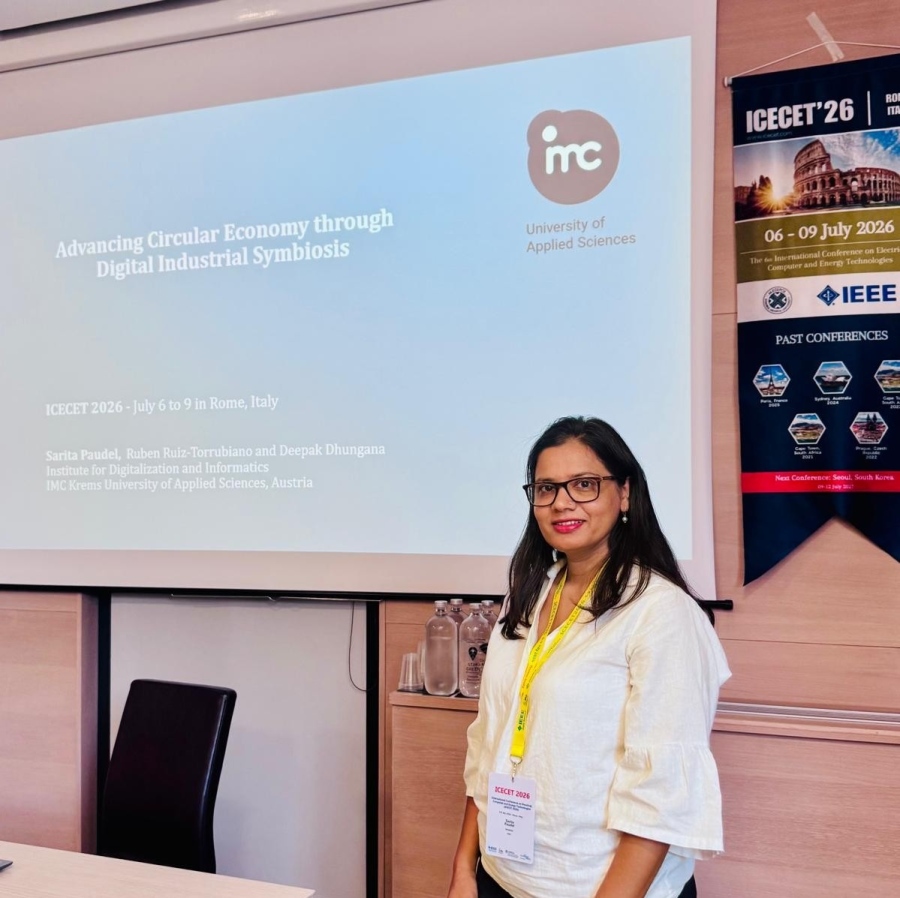
How can digital technologies help one company’s waste become another company’s resource? This question was at the heart of SymbioTech research presented at ICECET 2026 in Rome.
From 6–9 July 2026, researchers and technology experts gathered in Rome, Italy, for the International Conference on Electrical, Computer and Energy Technologies (ICECET 2026). Among the research presented was the SymbioTech-related paper “Advancing Circular Economy through Digital Industrial Symbiosis,” authored by Sarita Paudel, Ruben Ruiz Torrubiano and Deepak Dhungana.
Presented by Sarita Paudel, the paper explored how digital frameworks can help industries identify opportunities to exchange resources across traditional sector boundaries. Instead of treating by-products, surplus materials, excess energy or water as waste, Digital Industrial Symbiosis creates opportunities for these resources to become valuable inputs for another company.
This is also one of the central ideas behind SymbioTech: making industrial symbiosis more accessible and practical by combining circular economy principles with digital technologies, data and new forms of collaboration.
From industrial waste to shared value
Industrial symbiosis depends on companies being able to find the right partners, understand available resource streams and assess whether an exchange is technically, environmentally and economically viable. In practice, however, information is often fragmented and potential partners may operate in completely different industries.
Digitalisation can help bridge these gaps.
The research presented at ICECET highlighted how data-driven approaches, interoperable systems and digital decision-support tools can make it easier to identify and evaluate potential symbiotic relationships. By improving the flow of information between companies, these technologies can lower some of the barriers that currently make cross-industry collaboration difficult.
The result is a model in which circularity becomes more than waste reduction. Resources remain in productive use for longer, companies can reduce their dependence on primary raw materials, and new forms of cooperation can create both environmental and economic value.
Turning SymbioTech research into practical solutions
The paper draws on activities carried out within the SymbioTech project and contributes to the project's wider ambition to advance the circular economy through Digital Industrial Symbiosis.
These ideas are increasingly being translated into practical SymbioTech results, including the development of digital tools, AI-supported solutions and learning programmes designed to help companies and future SymbioTech Managers recognise and facilitate industrial symbiosis opportunities.
Presenting the research at ICECET 2026 also brought the SymbioTech approach into a wider international research and technology community, opening another space for discussion on how digital innovation can help industries move from traditional linear production models towards more connected, resource-efficient and circular industrial ecosystems.
Because in a circular economy, what leaves one production process does not necessarily have to become waste. With the right connections, data and tools, it can become the starting point for another.
 Funded by the European Union. Views and opinions expressed are however those of the author(s) only and do not necessarily reflect those of the European Union or the European Education and Culture Executive Agency (EACEA). Neither the European Union nor the granting authority can be held responsible for them.